BalanceBikeToddler
Where a Ride-On Car Is Safe to Drive
Driveway, garden, pavement: the surface and the boundaries decide more about safety than the top speed on the box.
By BalanceBikeToddler Editorial Team ·
Short answer: Driveway, garden, pavement: the surface and the boundaries decide more about safety than the top speed on the box.
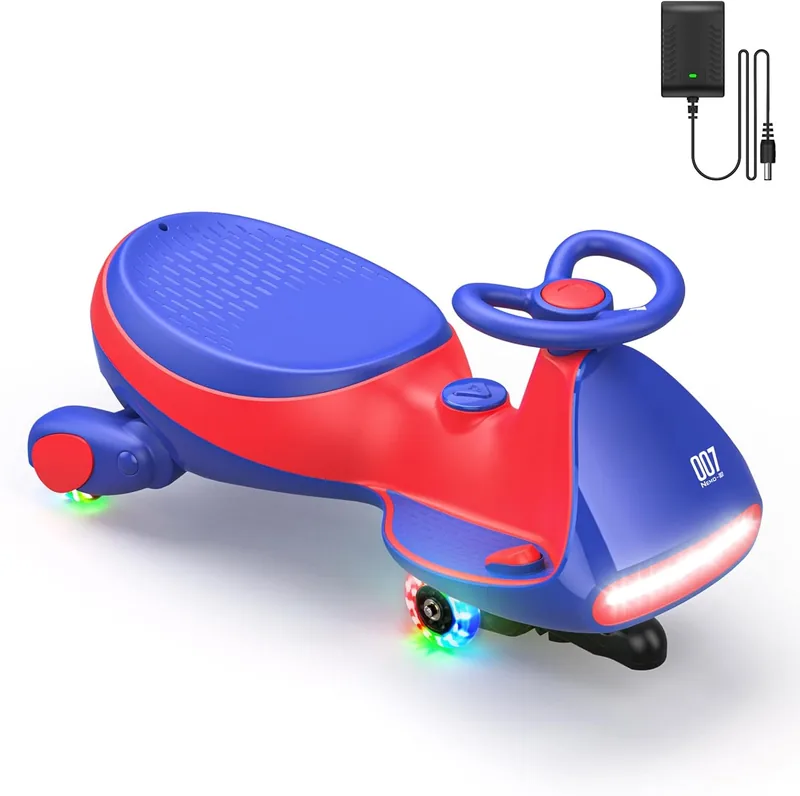
The safety question about a ride-on car is usually framed as a question about the car: how fast, how heavy, what does it have for brakes. In practice the venue decides more. A slow car on an open slope beside a road is a worse arrangement than a faster car in an enclosed yard, and the difference is entirely about where the toy is used.
Judge the space by its edges, not its size
A suitable space has a boundary that stops the car before it meets anything that matters. A wall, a fence, a hedge, a raised kerb. What matters is not how large the space is but whether the car can leave it without an adult noticing.
Walk the perimeter before the first drive and look for three things: gaps wide enough for the car, a slope that leads towards the gap, and anything the car could run into at the far end. A garden with a gate that opens onto a pavement is not an enclosed space, whatever its size.
Flatness matters more than length
A ride-on car steers by pointing its front axle, and a small child corrects it slowly. On flat ground that is fine. On a slope the car accelerates by itself, the child's correction arrives late, and the adult's remote is being used to brake rather than to supervise.
If the only available space slopes, choose the flattest part of it and mark the top end. Driving downhill towards a wall is a different activity from driving on the flat, and a two year old is not learning anything useful from the first one.
Surfaces, in order of difficulty
Smooth pavement is the easiest. Short, even grass is next, because it slows the car and softens a fall. Long or wet grass is worse: it hides unevenness and it takes torque the car may not have. Gravel and loose stones are the hardest, because they move under the wheels and the car can slide sideways without the child turning.
That ordering is also a sensible progression. Start where the surface is easiest and the child will spend the first sessions learning to steer rather than to recover.
The boundaries that are not physical
Two rules do most of the work and neither is about the car.
The first is that a ride-on is never used near a road, a driveway entrance, or a parking area, even with an adult present. A car that a driver cannot see, moving at walking pace, is exactly the combination that goes wrong.
The second is that the adult's attention is the actual safety system. A remote within reach is not supervision if the adult is looking at a phone. The useful habit is to stand where the car's whole path is visible, which in most gardens means moving rather than sitting.
Other children in the same space
Siblings change the calculation. The child driving is concentrating on the car; the child not driving is often running nearby and is not watching the car at all. Give the waiting child a job that keeps them outside the car's path, and treat the car's route as a space to be kept clear rather than a space to be shared.
After the first few sessions
Once the child steers and stops reliably, the space can grow, but the edges should grow last. A larger area with the same boundaries is a reasonable next step. The same area with a boundary removed is a different activity, and it needs a fresh decision rather than an extension of the old one.
Related Reviews
Products Mentioned in This Guide
- Step2 Whisper Ride II Kids Push Car, Ride-On Car with Seat Belt and Horn, Quick Fold Handle, Stroller Alternative, Toddlers aSource-based score, full specs & safety checklist for the Step2 Whisper Ride II Kids Push Car, Ride-On Car with Seat Belt and Horn, Quick Fold Handle, Stroller Alternative, Toddlers a.
- Dream On Me Aero Travel Umbrella Stroller, One-Hand Quick Fold, 3-Point Safety Harness, Dual Brakes, Adjustable Removable Canopy, Lightweight Compact & Space-Saving, for 6 to 36 Months – BlackSource-based score, full specs & safety checklist for the Dream On Me Aero Travel Umbrella Stroller, One-Hand Quick Fold, 3-Point Safety Harness, Dual Brakes, Adjustable Removable Canopy, Lightweight Compact & Space-Saving, for 6 to 36 Months – Black.
- ANPABO 3-in-1 Electric Push Ride On Car, 12V Kids Ride On Toy w/Remote Control, 360° Spin, 5-Point Safety Belt, Colorful LEDSource-based score, full specs & safety checklist for the ANPABO 3-in-1 Electric Push Ride On Car, 12V Kids Ride On Toy w/Remote Control, 360° Spin, 5-Point Safety Belt, Colorful LED.
Continue browsing the full guide library.