BalanceBikeToddler
Speed Settings and Lockouts Explained
Most ride-ons ship a low-speed setting and a lockout. Why the slower setting is the one to start on, and how to use it well.
By BalanceBikeToddler Editorial Team ·
Short answer: Most ride-ons ship a low-speed setting and a lockout. Why the slower setting is the one to start on, and how to use it well.
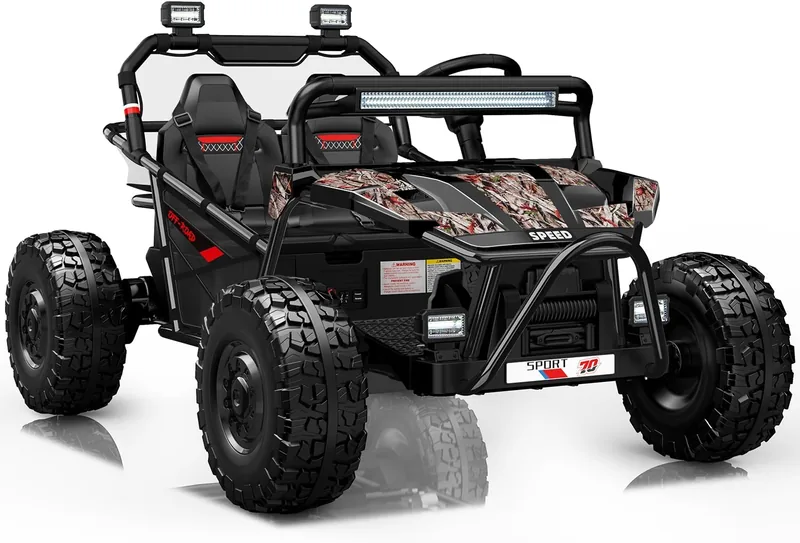
Almost every ride-on car ships with more than one speed, and most ship with a lockout that restricts the car to the lower one. Those two features are the cheapest safety equipment on the vehicle and the least used, usually because the box presents them as a performance option rather than as a control.
Two different mechanisms, often confused
A speed setting changes the top speed the car will reach. A lockout prevents the higher setting from being selected at all. They are not the same thing, and the difference matters: a two-speed car with the high gear available is a car whose speed is decided by whoever last touched the switch, which in a household with older children is not always the adult.
A soft start is a third mechanism, separate from both. It ramps the motor up over a moment instead of applying full torque immediately. It does not change the top speed at all. What it changes is the jolt at the start, which is the part that unseats a small child.
Read the listing for all three by name. A car with a soft start and no lockout is a different proposition from a car with a lockout and no soft start.
Why the slower setting comes first
The lower setting is not a beginner mode to be graduated out of as quickly as possible. It is the setting in which a child can actually observe cause and effect: press the pedal, the car moves a little, release, it stops.
At a higher speed the same sequence happens too fast to notice. The child learns that the car goes, but not that their foot controls it. That distinction is the entire skill.
There is a second reason. A slow car gives the adult time to intervene, whether with the remote or on foot. At the higher setting the car covers ground faster than an adult can cross a garden, and the remote becomes the only option.
Use the lockout as a rule, not a phase
The useful arrangement is that the higher setting is unlocked by an adult, for a specific session, in a specific place, and then locked again. Treating the lockout as a switch that gets flipped once and forgotten turns it into decoration.
That is especially true with more than one child. The oldest will learn the switch quickly, and the youngest will inherit whatever position it is in. A lockout that requires the key or the sequence described in the manual, rather than a button on the dashboard, is worth preferring for exactly this reason.
When to move up
Move up when the child demonstrably stops where they intend to, not when they ask for more speed. Intentional stopping is the one behaviour that separates driving from being carried, and it is the behaviour that a higher speed puts under pressure.
A useful test that costs nothing: ask the child to drive to a particular spot and stop there. If they can, the higher setting is reasonable. If the car overshoots and the stop was luck, it is not.
Speed is not the only variable
Two more factors decide how fast the car feels to the child. The surface is one: the same setting on grass is a slower and gentler ride than on smooth pavement. The load is the other: a heavier child, or two children, changes acceleration and braking distance on the same setting.
That means the lockout decision is not permanent. A setting that was right for one child on a driveway may be wrong for two children on a slope, and it is worth re-deciding rather than assuming.
Related Reviews
Products Mentioned in This Guide
- ANPABO 3-in-1 Electric Push Ride On Car, 12V Kids Ride On Toy w/Remote Control, 360° Spin, 5-Point Safety Belt, Colorful LEDSource-based score, full specs & safety checklist for the ANPABO 3-in-1 Electric Push Ride On Car, 12V Kids Ride On Toy w/Remote Control, 360° Spin, 5-Point Safety Belt, Colorful LED.
- First Ride On 36V Kids Ride On UTV, 2-Seater 400W Electric Car for Kids 6+, 5-8 MPH Speed, 14" EVA Wheels, Metal Frame, BluetSource-based score, full specs & safety checklist for the First Ride On 36V Kids Ride On UTV, 2-Seater 400W Electric Car for Kids 6+, 5-8 MPH Speed, 14" EVA Wheels, Metal Frame, Bluet.
- Dream On Me Aero Travel Umbrella Stroller, One-Hand Quick Fold, 3-Point Safety Harness, Dual Brakes, Adjustable Removable Canopy, Lightweight Compact & Space-Saving, for 6 to 36 Months – BlackSource-based score, full specs & safety checklist for the Dream On Me Aero Travel Umbrella Stroller, One-Hand Quick Fold, 3-Point Safety Harness, Dual Brakes, Adjustable Removable Canopy, Lightweight Compact & Space-Saving, for 6 to 36 Months – Black.
Continue browsing the full guide library.