BalanceBikeToddler
Ride-On Wheels: Wear and Replacement
Plastic wheels on pavement, rubber on grass: how the two wear differently, and the check that tells you a set is finished.
By BalanceBikeToddler Editorial Team ·
Short answer: Plastic wheels on pavement, rubber on grass: how the two wear differently, and the check that tells you a set is finished.
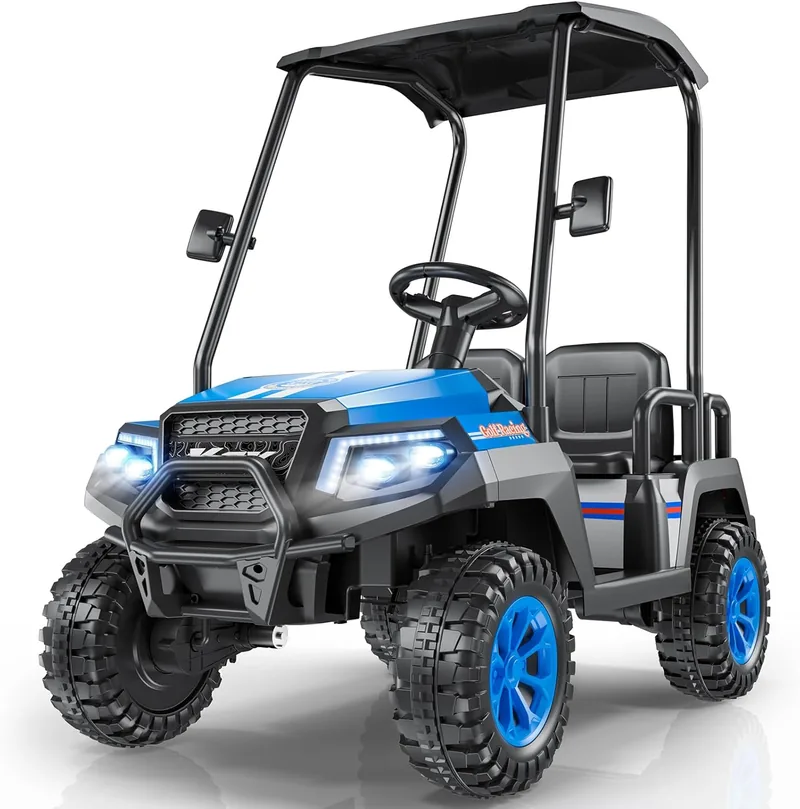
Ride-on wheels wear out, and they wear out in a way that is easy to miss because the car still moves. A worn wheel does not announce itself with a bang. It announces itself as a car that slides a little on a corner, spins when it starts, and eventually stops gripping at all.
Two wheel types, two wear patterns
Most ride-ons use one of two wheels. Hard plastic wheels are common on lower-priced cars. They roll efficiently on smooth pavement and are close to indestructible on it, because there is almost nothing to wear. On anything abrasive, or on stone, plastic wears at the contact edge and goes smooth.
Rubber or rubberised wheels are common on cars intended for grass. They grip far better on soft ground and they cushion the ride. They wear more like a shoe: gradually, at the tread, and with the tread pattern disappearing before the wheel fails.
The practical difference is that plastic fails by losing grip on a hard surface, and rubber fails by losing grip on a soft one. Whichever surface the car is used on is the surface to inspect.
The check that matters
Put the car on a flat surface and push it gently forward while watching each wheel. Three things to look for: whether the wheel turns freely, whether it wobbles as it turns, and whether all four are still roughly the same diameter.
A wheel that wobbles usually has a worn hub or a loose axle rather than a worn tyre, and it is the more urgent of the two problems because it stresses everything attached to it. A wheel noticeably smaller than the others means it has been spinning on abrasive ground, and the car will start pulling to one side.
Why rotating and swapping is worth the effort
On a car that is used mostly in one direction of turn, the outer wheels wear faster. Swapping front to back, or left to right where the hub allows, spreads the wear and pushes a replacement further out. It takes a few minutes and it is the cheapest maintenance a ride-on gets.
It also reveals problems early, because the swap requires taking each wheel off and looking at it.
What a replacement set should match
The wheel has to match the axle diameter and the hub fitting, and it has to be the same diameter as the ones on the other side. Mixing diameters creates a car that tracks badly and steers unevenly, which is worse than a uniformly worn set.
If the maker sells a set, prefer it, and check whether the set includes the hub fittings rather than only the tyres. A tyre without its hub is not a replacement, and the shortage is usually discovered mid-repair.
When the whole car is the answer
A car whose frame has cracked at a wheel mount, or whose axle has bent, is not a wheel problem. Look at the mounting points when the wheels are off. If the plastic around the axle is deformed or split, replacing wheels will not fix it, and continuing to drive it is how a small fault becomes a fall.
That inspection is the reason to take the wheels off at least once a season rather than only when something looks wrong. The wheels themselves are cheap; the mounting points are the part that decides whether the car is still worth repairing.
Related Reviews
Products Mentioned in This Guide
- Step2 Push Around Buggy Kids Push Car, Ride On Toy, Stroller Substitute, Includes Seat Belt & Horn, Made of Durable Plastic,Source-based score, full specs & safety checklist for the Step2 Push Around Buggy Kids Push Car, Ride On Toy, Stroller Substitute, Includes Seat Belt & Horn, Made of Durable Plastic,.
- Step2 Whisper Ride II Kids Push Car, Ride-On Car with Seat Belt and Horn, Quick Fold Handle, Stroller Alternative, Toddlers aSource-based score, full specs & safety checklist for the Step2 Whisper Ride II Kids Push Car, Ride-On Car with Seat Belt and Horn, Quick Fold Handle, Stroller Alternative, Toddlers a.
- ANPABO 3-in-1 Electric Push Ride On Car, 12V Kids Ride On Toy w/Remote Control, 360° Spin, 5-Point Safety Belt, Colorful LEDSource-based score, full specs & safety checklist for the ANPABO 3-in-1 Electric Push Ride On Car, 12V Kids Ride On Toy w/Remote Control, 360° Spin, 5-Point Safety Belt, Colorful LED.
Continue browsing the full guide library.