BalanceBikeToddler
Ride-On or Convertible Scooter
For a two-year-old the question is not which scooter, but whether a sit-on toy that later becomes a scooter is worth it. What each one actually is.
By BalanceBikeToddler Editorial Team ·
Short answer: For a two-year-old the question is not which scooter, but whether a sit-on toy that later becomes a scooter is worth it. What each one actually is.
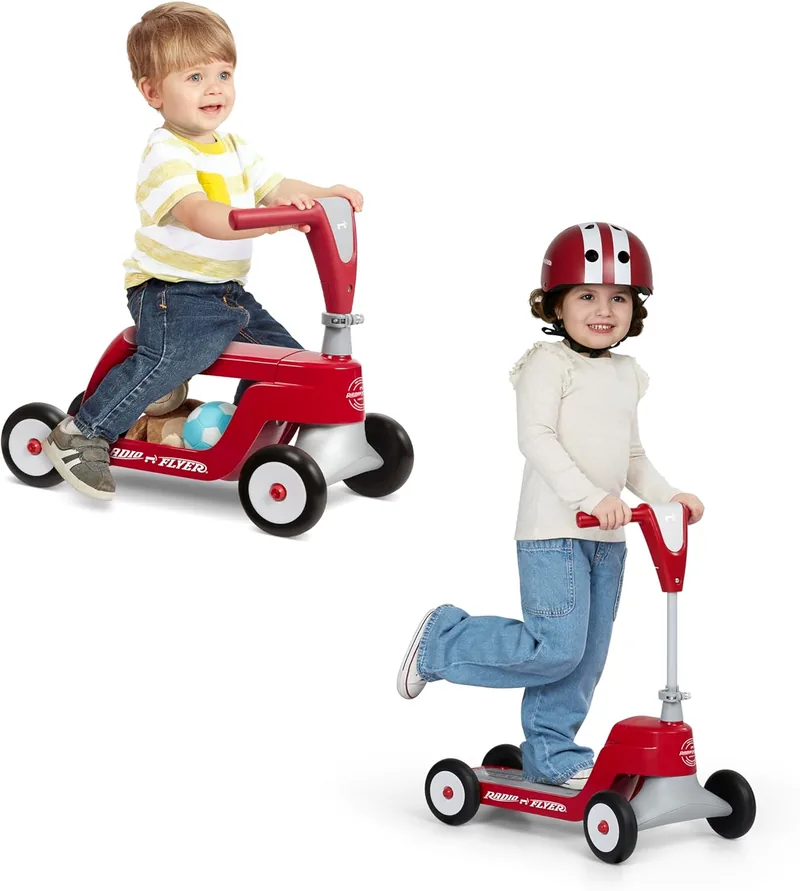
A two-year-old cannot ride a scooter. They can sit on something with wheels and be pushed, and they can stand on a deck that is low enough that falling off is a short trip. Those are two different toys, and the "convertible" category exists to sell one object that does both.
The question worth answering before you spend anything is whether that two-in-one is a real saving or a compromise that does neither job well.
What each shape actually is
A ride-on is a seat on wheels with a handle behind it. The child sits, an adult pushes. Nothing about it teaches balance, and nothing about it is a scooter.
A convertible starts in that seated position and later drops or removes the seat so the child stands on the deck and pushes with a foot. The wheels stay. The frame stays. What changes is where the child's weight goes.
That is the whole trick, and it is a legitimate one: the child gets used to the object, the height, and the wheels before being asked to balance on them.
The spec line that decides it
The number that matters is the deck height, not the age on the box.
A convertible that sits low — close to the ground in scooter mode — lets a small child put a foot down without the scooter leaning far enough to throw them. A convertible that keeps a high deck because the seat mechanism dictates the frame height will hand a toddler a scooter they cannot safely stop.
Look for the deck height relative to the wheel size, and compare it with the child's inseam. If the child has to reach, the scooter will tip every time they take a foot off.
Where the compromise shows up
Two failure points are common in this price band.
The first is the seat joint. A seat that clips on and off is convenient until the clip loosens, and then the seat rocks while the child is on it. A seat held by four bolts and a plate takes longer to remove and does not develop that rock.
The second is the handlebar. Convertibles often ship one height so that the same bar works behind a seat and in front of a standing child. That single height is usually right for one mode and wrong for the other. An adjustable bar covers both, and a bar that only adjusts over two centimetres covers neither for long.
What a convertible does not buy you
It does not buy a longer usable life than a scooter bought at the right time. The reasoning is easy to get backwards.
A convertible spends its first year as a ride-on. That is a year the child is not learning to balance, and a year of wear on wheels that were sized for sitting. When the child finally stands on it, the deck is the one the frame was built around, not the one their leg length now calls for.
The honest case for a convertible is not "one purchase instead of two". It is "one object the child is not afraid of". For a child who will not stand on an unfamiliar deck, that is worth paying for. For a child already happy on a low scooter, it is not.
How to decide in the shop
Three checks, in order.
First, put the child on the seat with shoes on and see whether their feet reach the ground when the seat is at its lowest. A ride-on whose seat is too high is a toy the child will slide off.
Second, take the seat off and put the child on the deck. If the deck is high enough that they cannot touch a foot down while holding the bar, this convertible is not ready for them yet, whatever the age range says.
Third, hold the bar and rock the whole object side to side. Any movement at the seat joint or the folding clamp is the wear you will be living with.
The short version
A ride-on is a seat. A scooter is a deck. A convertible is a bet that the child will accept the second after getting used to the first, and the bet pays off only when the deck sits low enough for their leg.
If the deck is low and the seat is bolted rather than clipped, the two-in-one is a real object. If either of those is wrong, buy the simpler thing for the age the child actually is, and buy the scooter later when their leg length says so.
Related Reviews
Products Mentioned in This Guide
- Graco SlimFit3 LX 3-in-1 Convertible Car Seat, Slim Car Seat Fits 3 Across, Rear Facing, Forward Facing, to Highback Booster Seat, Perfect for Baby Travel & Gift for New Parents, KunninghamSource-based score, full specs & safety checklist for the Graco SlimFit3 LX 3-in-1 Convertible Car Seat, Slim Car Seat Fits 3 Across, Rear Facing, Forward Facing, to Highback Booster Seat, Perfect for Baby Travel & Gift for New Parents, Kunningham.
- Green Mini 3 Wheel Scooter for Kids – Lean-to-Steer with LED Light-Up Wheels, Adjustable Handlebar, Wide Anti-Slip Deck, SmooSource-based score, full specs & safety checklist for the Green Mini 3 Wheel Scooter for Kids – Lean-to-Steer with LED Light-Up Wheels, Adjustable Handlebar, Wide Anti-Slip Deck, Smoo.
- Graco Extend2Fit Convertible Car Seat, Rear and Forward Facing Car Seat with Adjustable Extension Panel for Extra Legroom, GrSource-based score, full specs & safety checklist for the Graco Extend2Fit Convertible Car Seat, Rear and Forward Facing Car Seat with Adjustable Extension Panel for Extra Legroom, Gr.
Continue browsing the full guide library.