BalanceBikeToddler
A First Scooter's First Year
What actually wears on a small child's scooter in year one, and which of it decides whether the toy is still safe rather than merely scruffy.
By BalanceBikeToddler Editorial Team ·
Short answer: What actually wears on a small child's scooter in year one, and which of it decides whether the toy is still safe rather than merely scruffy.
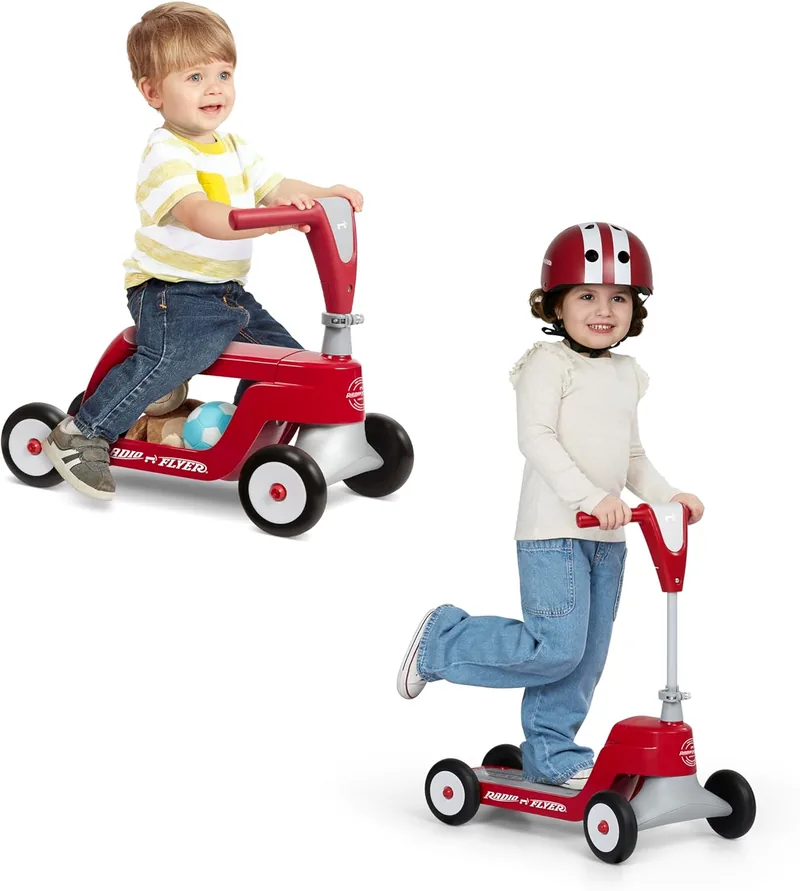
A first scooter is bought for a child who weighs little and rides slowly, so it is easy to assume it needs no attention. What wears in year one is not the thing that gets abused. It is the thing that gets adjusted, folded, and left outside.
Four parts account for almost all of it, and only two of them decide whether the scooter is still safe.
The wheels, and what "worn" means on a plastic wheel
Small scooters run solid plastic or urethane wheels. They do not go flat; they wear a flat spot.
A flat spot appears when the child brakes by dragging a foot or by stomping the rear fender over and over. Once a wheel has a flat, every rotation thumps, the child feels it through the deck, and they stop riding it as much. That is a comfort failure, not a safety one — but it is the failure that ends a toy's life early.
Turn the scooter upside down and spin each wheel. A wheel that stops in the same place every time has a flat. A wheel that wobbles side to side has a bearing or axle problem, which is the safety-relevant one: a seized wheel stops the scooter abruptly and puts the child over the bar.
The folding clamp, which is the real safety item
On a folding scooter the clamp is the only thing holding the deck to the steering column, and it is the part a child will play with because it is the part that moves.
The check takes ten seconds: fold and unfold it five times, then try to move the deck and the column against each other with the clamp closed. Any rotation or rock means the clamp is not doing its job, and a scooter whose deck can rotate under a standing child will eventually fold at the wrong moment.
Adjust the clamp tension if the design allows it. If it does not, and the joint moves, the scooter is done — this is not a part to nurse along.
The rear fender brake
The fender is pressed by a heel, so its wear depends on how the child stops, and children stop in the way that feels urgent rather than the way that is gentle.
Look for two things. The fender should still spring back to a clear gap above the wheel; a fender that sags and drags is a brake that is always slightly on, which heats the wheel and teaches the child nothing about control. And the fender should still reach the wheel at all — a fender worn thin at the contact point stops braking before it looks broken.
The handlebar clamp
The bar is the part that gets adjusted most, because it is how the scooter grows with the child, and every adjustment is a chance for the clamp to be left half tight.
The failure is quiet: the bar slides down under the child's weight while they are riding. Test it by putting the bar at the height you intend to use and pressing down hard on the grips. If it creeps, tighten the clamp; if it still creeps at the specified torque, the clamp has worn out of round and the assembly needs replacing rather than re-tightening.
What none of this is
None of these checks is a substitute for the manufacturer's stated limits, and none of it is a repair schedule. The point is narrower: four parts, checked in this order, tell you whether the scooter a child is riding tomorrow is the same object that was safe last week.
The order that matters
Wheels first, because a wobble is the one that hurts. Then the folding clamp, because it is the only joint that can fail while the child is standing on it. Then the fender, then the bar clamp.
The whole pass takes a few minutes and it is worth repeating at the change of every season — the same interval at which the bar gets moved up a notch.
Related Reviews
Products Mentioned in This Guide
- Dream On Me Aero Travel Umbrella Stroller, One-Hand Quick Fold, 3-Point Safety Harness, Dual Brakes, Adjustable Removable Canopy, Lightweight Compact & Space-Saving, for 6 to 36 Months – BlackSource-based score, full specs & safety checklist for the Dream On Me Aero Travel Umbrella Stroller, One-Hand Quick Fold, 3-Point Safety Harness, Dual Brakes, Adjustable Removable Canopy, Lightweight Compact & Space-Saving, for 6 to 36 Months – Black.
- Green Mini 3 Wheel Scooter for Kids – Lean-to-Steer with LED Light-Up Wheels, Adjustable Handlebar, Wide Anti-Slip Deck, SmooSource-based score, full specs & safety checklist for the Green Mini 3 Wheel Scooter for Kids – Lean-to-Steer with LED Light-Up Wheels, Adjustable Handlebar, Wide Anti-Slip Deck, Smoo.
- Jetson Jupiter Kids 2-Wheel Light-Up Kick Scooter, LED Lights on Handlebar, Stem, Wheels & Deck, Adjustable Handlebar, Rear BSource-based score, full specs & safety checklist for the Jetson Jupiter Kids 2-Wheel Light-Up Kick Scooter, LED Lights on Handlebar, Stem, Wheels & Deck, Adjustable Handlebar, Rear B.
Continue browsing the full guide library.